


The impact of living in a Life Plan Community on residents’ health and wellness

Updated: Feb 9, 2022
The entire study can be found on Mather Institute's website.
matherinstitute.com . This post will focus on the results as they relate to residents. A subsequent post will focus on organizational data.

The purpose of the Age Well Study is to help providers and residents better understand the impact of living in a Life Plan Community on residents’ health and wellness. In this particular year of the study, analysis seeks to identify which individual and organizational factors are associated with stress and resilience during the COVID-19 pandemic.
THE AGE WELL STUDY INCLUDES FOUR MAIN COMPONENTS:
1) self-administered organizational surveys completed by one staff member from each participating Life Plan Community
2) self-administered surveys completed annually by residents of Life Plan Communities for five years
3) semi-structured interviews with a subset of residents from three communities
4) secondary data analysis with a comparison sample of older adults living in the community at large
This report describes the results of an analysis of survey responses from Year 4 .
Resident characteristics include personality, personal resources, and demographic factors .

RESIDENT STRESS Respondents completed four items to assess the extent to which they exhibited characteristics associated with stress (Cohen et al ., 1983) . On a scale ranging from 1 to 5, the average level of stress across all respondents was 1 .44, which indicates respondents generally exhibited low levels of stress . More than nine out of 10 (62 .15%) indicated they “never” or “almost never” felt that they were unable to control important things in their lives, while 85 .40% reported that they “never” or “almost never” felt that their difficulties were piling up so high that they could not be overcome . A large majority (80 .10%) of respondents indicated they were confident in their ability to handle personal problems either “often” or “fairly often .” Slightly fewer respondents agreed that things go their way “very often” or “fairly often” (71 .60%) . Figure 1 depicts the frequency with which respondents exhibit each of the four characteristics associated with stress .

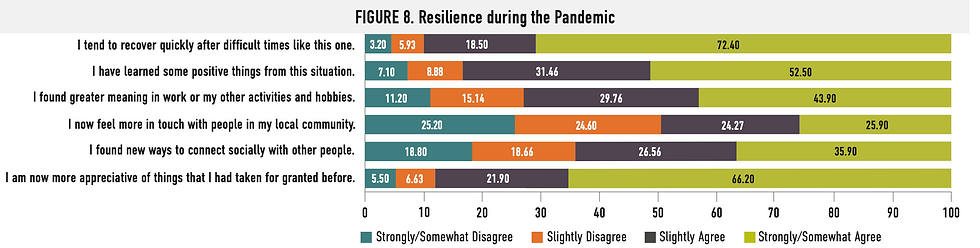
RESIDENT RESILIENCE Resilience is defined as an individual’s ability to cope with adversity, stress, and risk associated with stressful experiences (Bonanno, 2004) . It serves to protect a person from stressful experiences, promote recovery from complications the experiences have caused, and consequentially encourage personal development (Fontes & Neri, 2019) . Lower resilience is associated with worse mental health outcomes, including depression and anxiety (García-Fernández et al ., 2020) . Exhibiting concerns about COVID-19 increases the likelihood of developing these characteristics (Killgore et al ., 2020) .
COPING STRATEGIES Coping has been defined as the continuous changing of behavioral and mental efforts to manage internal and external demands causing stress . It serves to regulate stressful emotions and help people adjust to aspects of their environments that may be causing the distress (Lazarus & Folkman, 1982) .
In the Age Well Study, respondents were asked to indicate if they had engaged in any of seven specific activities to cope with stress related to the COVID-19 pandemic . Nearly all (98%) residents engaged in at least one of the seven coping strategies, with an average of 3 .3 coping strategies each . Most coped with the pandemic by talking with friends and family (89 .2%) and/or by increasing the time that they spent on intellectual activities like reading or doing puzzles (81 .6%) . Respondents were least likely to talk to a mental health provider (such as therapist, psychologist, or counselor) for support (4 .3%) . Figure 18 displays the number of residents who reported engaging in each of the coping strategies.


Comments